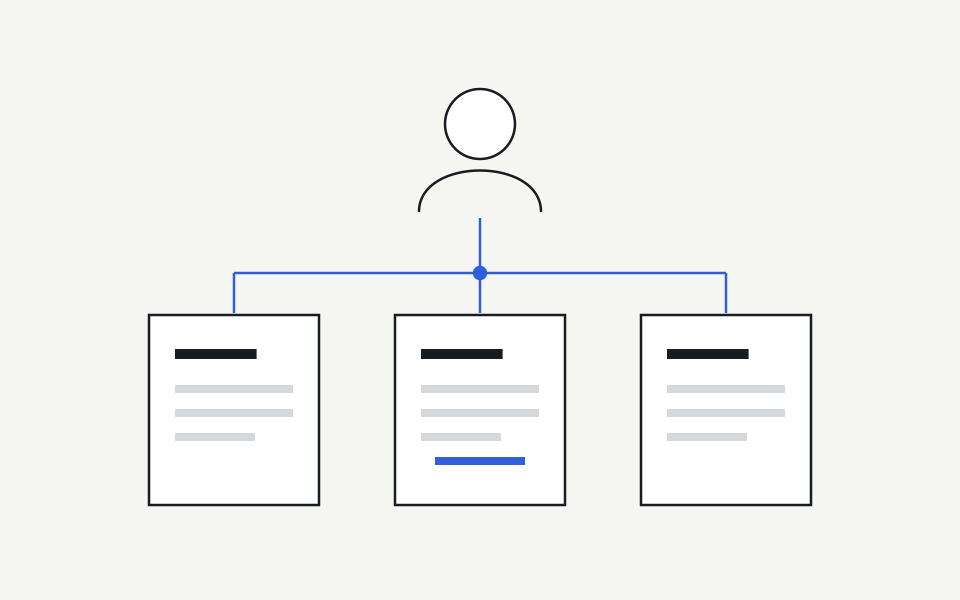
Use this worksheet to make ownership of an important company topic explicit. Complete one copy for commercial terms, onboarding, engineering standards or another recurring area of work. Keep the completed record alongside the original source; do not create a competing copy of every document.
Filled example: commercial terms
In this fictional company, the commercial director owns the rule for non-standard payment terms. A sales operations colleague maintains the handbook. The administrator connects the selected source and configures the intended audience. Employees report disputed answers with the source link. These are responsibilities a company assigns, not four new approval queues.
Correcting a broken handbook link is routine source maintenance. Changing who may approve non-standard terms is a consequential guidance decision for the owner. After the decision is published, test an ordinary proposal request and an exception request, including a person outside the authorised audience.
| Responsibility | Example owner | Concrete action |
|---|---|---|
| Maintain reference facts | Sales operations | Update the current service description in the original handbook |
| Approve consequential guidance | Commercial director | Approve a revised payment exception rule and its audience |
| Configure delivery | Company administrator | Select the source, apply the agreed audience and check an actual AI answer |
| Report a correction | Employee | Send the disputed statement and source link to the topic owner |
1. Name the topic and accountable person
Choose a topic narrow enough that one person can make a clear decision. “Company knowledge” is too broad; “commercial terms used in new proposals” is more useful. The owner is accountable for the correctness of the guidance, even if another person maintains the document or configures the integration.
| Field | Your answer |
|---|---|
| Topic | ________________________________________________ |
| Tasks this topic supports | ________________________________________________ |
| Accountable owner | ________________________________________________ |
| Source maintainer | ________________________________________________ |
| Backup / escalation contact | ________________________________________________ |
2. Decide which source governs
Identify the current source with a precise location. Then list supporting and historical material. A supporting document may provide an example or explanation without defining policy. Record unresolved conflicts as decisions for the owner; do not label two contradictory sources equally authoritative and hope an assistant picks correctly.
| Source role | Location | Reason |
|---|---|---|
| Current source | ________________________ | ________________________ |
| Supporting source | ________________________ | ________________________ |
| Historical source | ________________________ | ________________________ |
| Excluded source | ________________________ | ________________________ |
3. Write the guidance only if guidance is needed
Some topics need current reference information and no additional instruction. Where a consequential rule is needed, write it in plain language. Include the condition, required action and audience. Avoid copying the entire handbook into a prompt or converting descriptive background into a mandatory rule.
Use this drafting template: “When [condition], [audience] must [action]. [Owner or role] can approve an exception. The current supporting source is [location].” An illustrative example is: “Before offering non-standard payment terms, the commercial team must obtain approval from the commercial owner.” This is an example, not a Steer requirement for your company.
- Reference only, or explicit guidance required? ______________________________
- Proposed guidance: ______________________________________________________
- Exception owner and route: ______________________________________________
- Approval decision and date: ______________________________________________
4. Specify audience and access boundaries
Name the company, team or role that should receive the context. Check that the source connection supports the intended access boundary. If personal or restricted material is involved, record the additional evidence required before inclusion. The owner’s approval of a rule does not grant people access to otherwise restricted source documents.
| Question | Decision |
|---|---|
| Who needs this context? | ________________________________________ |
| Who should not receive it? | ________________________________________ |
| What source access can be verified? | ________________________________________ |
| Which uncertainty blocks inclusion? | ________________________________________ |
5. Define changes, reviews and corrections
Record which changes are routine source maintenance and which require a new guidance decision. An updated reference link is different from changing an approval threshold. Set a review trigger tied to the business, such as a new service launch or revised commercial policy, and add a review date where useful.
Give employees a clear correction route: report the task, the disputed statement and the source they believe is current. The owner should decide whether to fix the source, revise guidance or explain the existing decision. Preserve a short record of the outcome so the same issue does not need to be rediscovered.
- Routine updates handled in the source: ____________________________________
- Changes requiring owner approval: _________________________________________
- Review trigger / date: ___________________________________________________
- Where employees report a correction: ______________________________________
6. Prove the record is useful
Ask an ordinary task that needs this topic in each intended AI tool. Check that the answer uses the current source and applicable guidance for the intended audience. Then ask from an excluded identity and test a harmless source update. Record actual outcomes separately from intended behaviour.
| Evidence | Result / date |
|---|---|
| Ordinary task uses the current source | ________________________________________ |
| Applicable guidance is reflected | ________________________________________ |
| Excluded identity receives no restricted content | ________________________________________ |
| Source update reaches a fresh answer | ________________________________________ |
| Owner accepts the observed result | ________________________________________ |
Continue with a practical next step
Put the context to work.
See how Steer connects maintained knowledge and approved ways of working.
Explore Steer