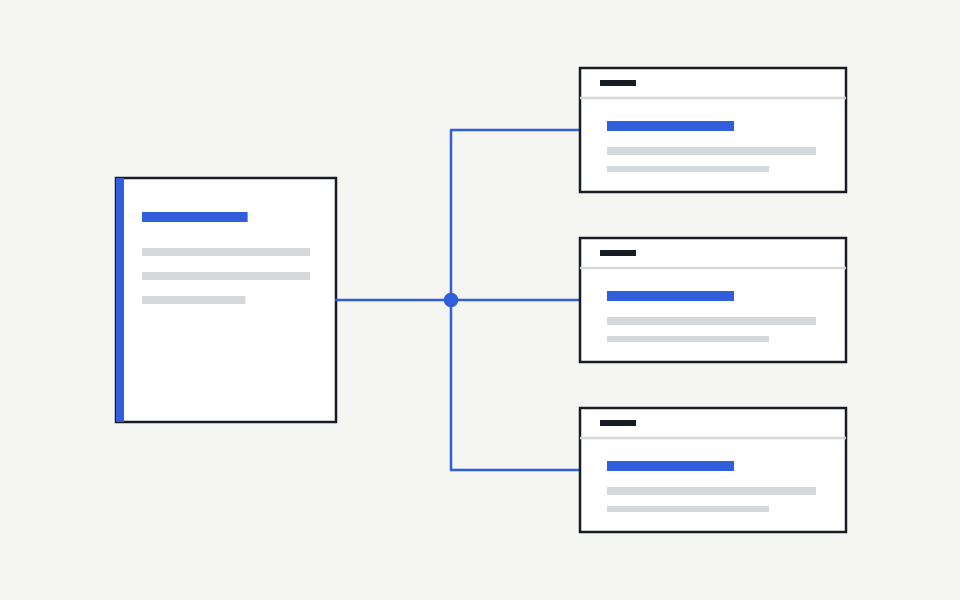
Sharing company context across ChatGPT and Claude means making the same current sources and applicable guidance available to authorised people in both tools. It does not require identical answers, shared chat histories or copying every employee’s private information into a central repository.
Define what should be consistent
Different assistants may organise an answer differently. One might write a concise proposal outline while another starts with a detailed narrative. That variation is often useful. The important question is whether both use the correct service description, current terms and applicable company rules.
Create a short list of invariants for each test task. In a fictional consultancy, a six-week operations review might have three required phases and a named approval step for non-standard terms. Those facts should remain consistent across tools even when wording and structure differ. Avoid scoring consistency by whether two paragraphs happen to look alike.
Keep shared information outside individual chat histories
An employee’s chat history contains a mixture of useful work, experiments, incomplete assumptions and personal context. It is a poor default location for company policy. A rule that matters across the organisation needs a named owner and a source that colleagues can find and challenge.
Keep company information in the systems where it is maintained, then make relevant material available through supported connections. Personal preferences can remain personal. A writer’s preference for shorter paragraphs is different from a commercial requirement to seek approval before offering non-standard payment terms.
Separate installation from useful delivery
A connection has several stages: an administrator makes it available, the intended person authorises access, the AI tool invokes it and the final answer uses the returned information appropriately. Seeing a connector in a menu proves only part of that chain.
Steer uses authenticated connections for its existing ChatGPT and Claude destinations. Applicable plans, workspace settings and administrator actions matter. The assistant still decides when to use available tools, so test natural requests rather than relying exclusively on prompts that explicitly say to call Steer. A successful ordinary request is stronger evidence of a usable workflow.
Use the same evaluation brief in both tools
Write one request that reflects real work and submit it separately in fresh conversations. Give the evaluator the expected source facts and guidance, but do not put the full answer into the user’s prompt. Otherwise the test may only show that both tools can repeat information pasted directly into the conversation.
Review the sources as well as the prose. A fluent answer that cites an old deck should not pass because it sounds convincing. Record whether the answer identified uncertainty and whether the person could follow its source links. Repeat the exercise for more than one audience before describing the setup as company-wide.
| Check | What to look for |
|---|---|
| Current knowledge | Both answers use the designated current source |
| Applicable guidance | The relevant company rule appears where the task requires it |
| Audience | Neither answer includes material outside the person’s access |
| Attribution | The source links support the statements made |
| Uncertainty | Missing information is identified rather than invented |
Test a change, not just the initial setup
Update one selected source through its normal system of record and ask the task again after the connection has processed the change. Then test a guidance change through its approval and publication process. These are different operations: a factual source update should not need the same ceremony as changing a consequential company requirement.
Also remove access for a test user or disconnect a source. A shared-context setup needs a clear answer to what happens next. Older chat messages may still contain previously delivered information; changing source access is about preventing new unauthorised delivery, not erasing content already visible in a provider’s conversation history.
Let people choose tools without fragmenting company knowledge
A useful cross-tool approach allows teams to choose an assistant that suits their task while maintaining a shared basis for company work. It should reduce repeated configuration and make corrections easier to apply, rather than forcing everyone to adopt the same writing style or conversation workflow.
Begin with one owner, a few current sources and a small set of normal requests. Compare evidence from both tools, identify gaps and expand only when the experience is useful. The goal is consistent company facts and decisions with room for different AI tools to contribute their own strengths.
Sources and further reading
Continue with a practical next step
Put the context to work.
See how Steer connects maintained knowledge and approved ways of working.
Explore Steer